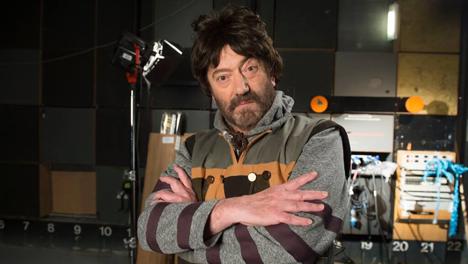
Kellyvision was a series that looked behind the scenes of the world of television. It was presented by Chris Kelly and was shown on Children's ITV in the late 80s. One of these episodes was based on computer graphics used in television, and they looked behind the scenes of Knightmare at Anglia Television and The Moving Picture Company in London.
This was broadcast in 1988. Many thanks go to Peter Lee for sending this in.
This is Anglia Television in Norwich, and on the right is the Knightmare control centre packed full with equipment.
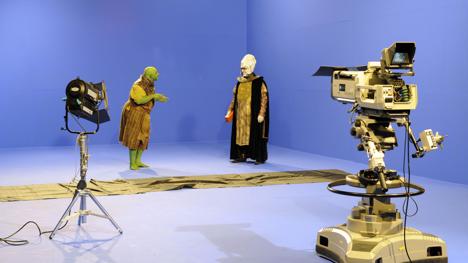
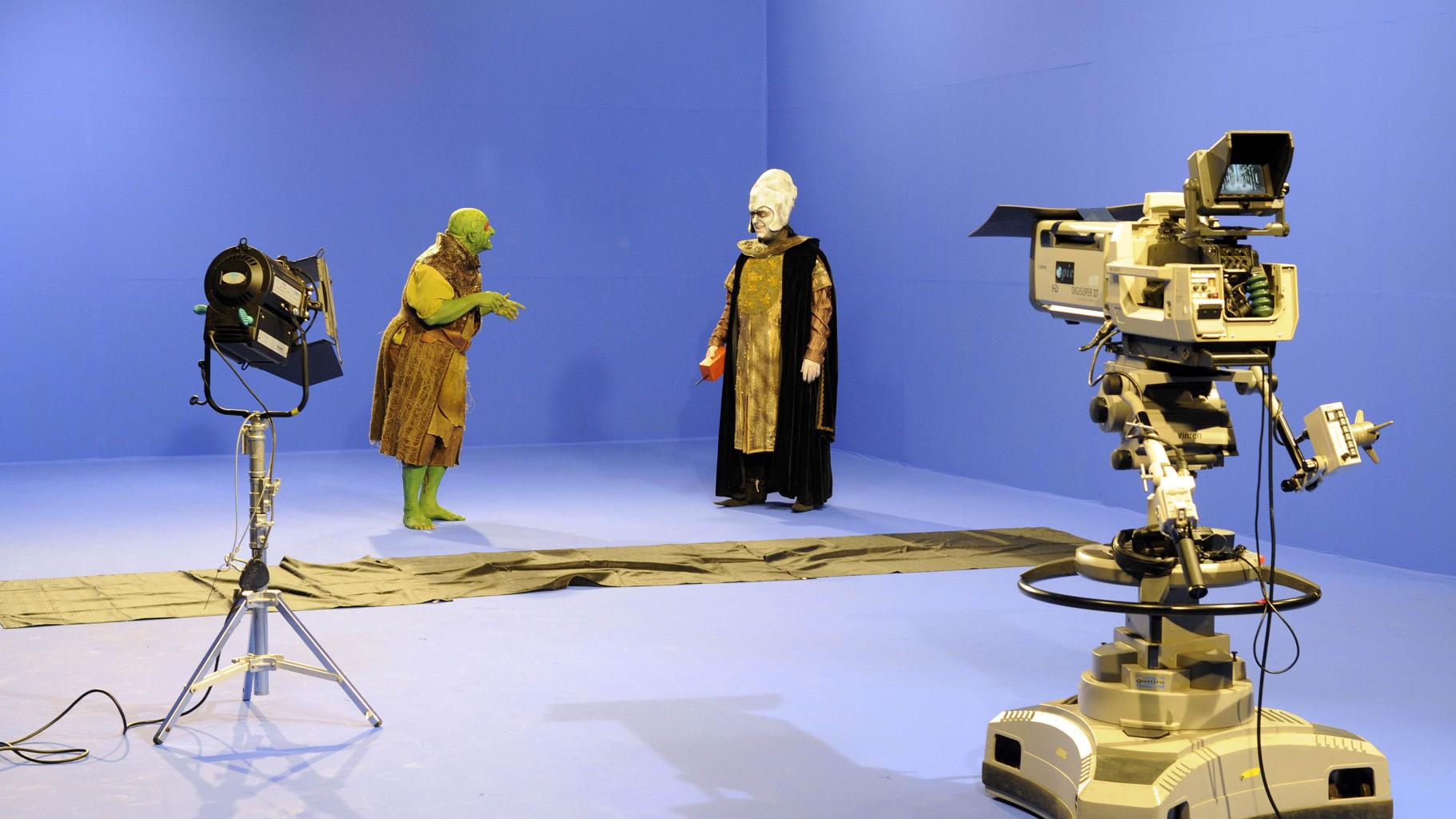
After a quick description of the programme, we are shown the blue room, where white lights shine down to the studio floor to create an even light on the totally blue set. That's so the technicians can create an effect called 'Chromakey'. The camera that looks at the set (right) is blind to the blue - it doesn't pick up any of it...
...so that in this shot the only real things are the stairs, table, the workers and the camera (left). Everything else is created by computer graphics, and is controlled by Robert Harris and his Supernova.
Robert can paint on colours and effects to the rooms by using an electronic pen and pad. These rooms were all originally painted by artist David Rowe, and Robert can make adjustments with his computer by choosing from an electronic palette. Meanwhile, the dungeoneer (left) is fitted with an earpiece so he can hear his colleagues' directions...
...and then sets off on his adventure (right). Robert, using his computer, controls the graphics in the game.
At his desk, he had a 24-bit machine along an 8-bit machine. He uses the 24-bit machine to achieve this graphic of a level 1 room (right). As soon as the dungeoneer enters the room, he can press a key and the 4 doors display portcullises. He can then press another key to reveal the clues on the floor. Once the dungeoneer steps on the right letters...
...he can then press another key to unlock the doors. The picture on the right was the final shot of this feature, and shows the narrator in the place of the usual wall monster!
If you would like to find out more about the making of Knightmare, read the document in the History section.