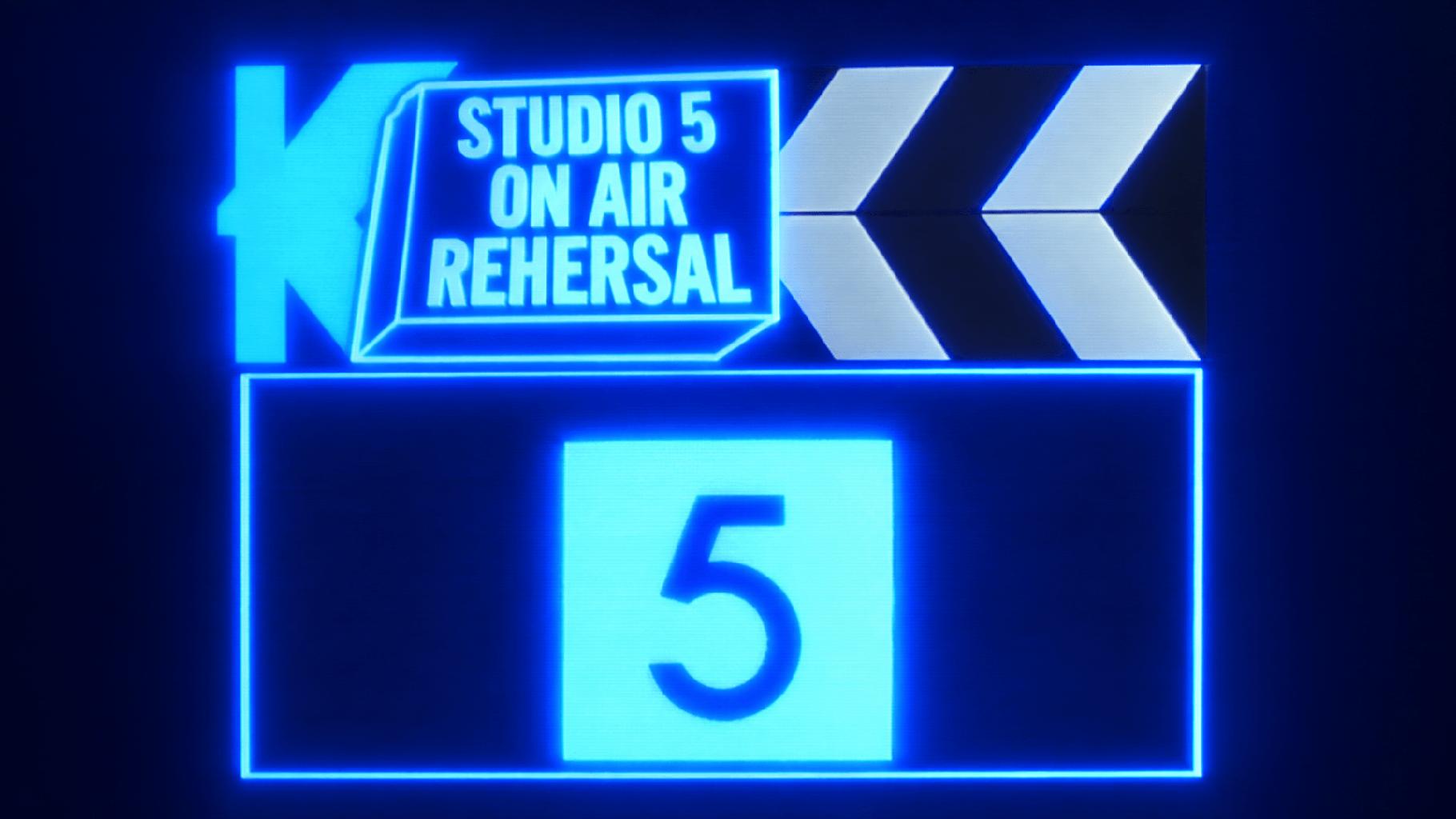
Knightmare featured on Kellyvision, a short-running CITV series from 1988 that went behind the scenes to explore television production and effects.
Hosted by Chris Kelly, formerly of Anglia Television, the nine-episode series was shot and produced by Tyne Tees Television.
Some of its action was captured locally in the north-east, including ITV Sport coverage at Gateshead Stadium and a behind-the-scenes looks at The Roxy, a music chart show made in Newcastle.
But much of the series travelled further afield. There are features shot on location at ITN Headquarters and at Anglia Studios in Norwich.
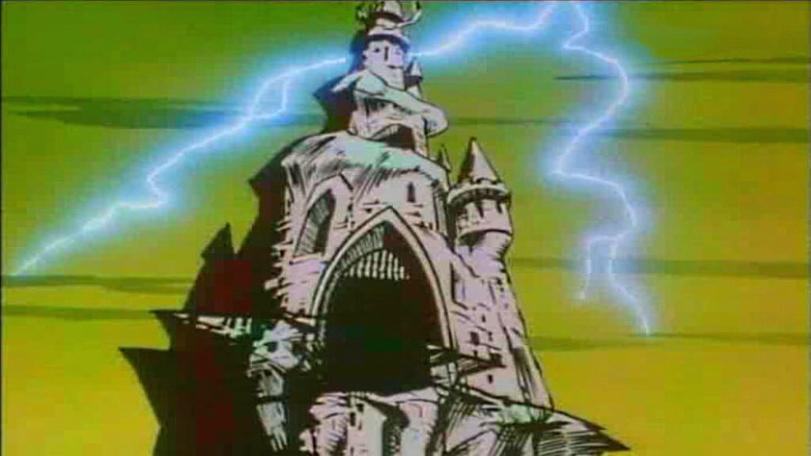
Knightmare featured in an episode about computer graphics, as part of an in-depth report on Robert Harris's Travelling Matte Company.
It's among - if not exclusively - the most detailed behind-the-scenes footage of Knightmare available.
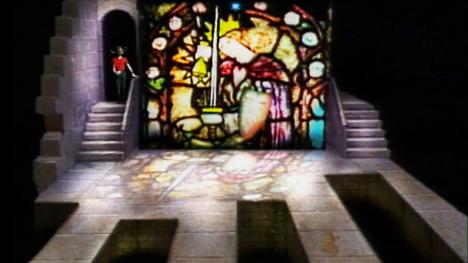
Harris describes how some of the early computer effects are created and is shown using his graphics palette to add colour intensity to David Rowe's hand painted artwork.
The episode continues with a look at how the Travelling Matte Company creates its annual showreel.
High pitched
Chris Kelly was involved with World in Action, ITV's hallmark investigative current-affairs programme. Kellyvision retains that commitment to serious documentary-making.
It was pitched educationally and at a high level. It covered sports production, news production, recording with animals, stunts and effects.
The often-uncredited reporter on the show was Gareth Jones (aka Gaz Top). Gaz would carry on the educational mantle through the scientific curiosity show How2, which he co-presented for its entire 16-year span.
An unaired Kellyvision episode on the use of guns and explosions was withdrawn following a mass-shooting incident after the footage was taken.
Not that Knightmare was deterred. In the relative security of a fantasy environment, bomb explosions had ended a whopping four quests by the end of its second series in 1988.
DownloadWatch a low-res clip (3.72MB)
Transcript
Pretty soon, graphics on paper will be more-or-less a thing of the past because the graphic designer's work has been revolutionised recently by the introduction of high-tech computer design which can produce literally an endless variety of visual effects. Absolutely fascinating and fantastic.
This is the HQ of the MPC (Moving Picture Company) right in the middle of London, Soho... They're probably the leading creators of computer graphics and video special effects, certainly in Britain, possibly even the world.
First, we're going over to Anglia TV in Norwich for a look at Knightmare, the adventure game show which also relies heavily on computer graphics.
Gaz Top [Narrator]
This is the control room for Knightmare. It's a real nerve centre. Just check out all that computer equipment and the technology lying around that's used to control the actual programme.
Remember, this is a computer-generated game where an adventurer or dungeoneer is guided by three colleagues through a maze of adventures.
The threesome follows the dungeoneer's movements on a TV set and pass on instructions. Various things occur in front of him, all controlled by the computer nerve centre as he continues through the game.
Elsewhere on the studio floor, white lights shine downwards to create an even light on the totally blue set. That's so that technicians can create an effect called chromakey.
The camera that looks at the set is blind to the blue. It doesn't register or pick up anything that's blue. So that on this shot, the only real things are the studio camera, the men working, and the table.
Everything else is created by computer graphics and controlled by Robert Harris and his Supernova. Using and electronic pen and drawing pad, Robert can literally paint on colours and effects and change the appearance of a Knightmare room as if by magic.
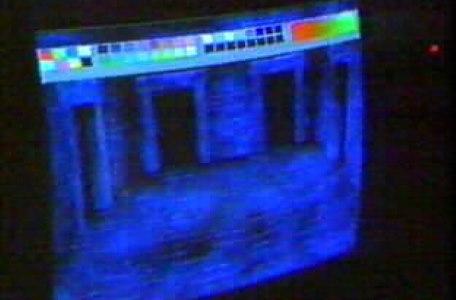
These rooms in fact all the backgrounds were originally painted by artist David Rowe, and Robert can make adjustments with his computer choosing from an electronic palette of colours.
Meanwhile with the intrepid adventurers, one of them is prepared and fitted with an earpiece so he can hear his colleagues' directions and is set off on his travels.
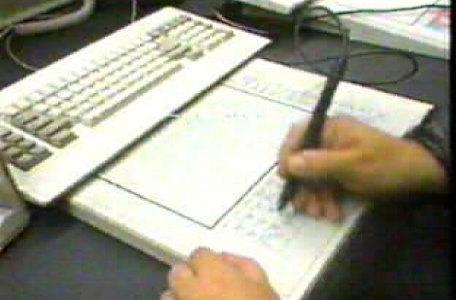
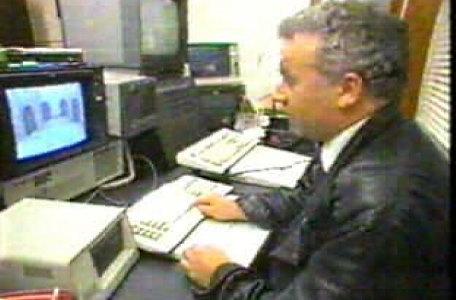
Robert, using his computer, will be controlling the graphics in the game. It's his finger on the button that literally reacts to the adventurers' instructions.
Robert Harris [Travelling Matte]
"What we've got here is two computer graphics systems: one, what's called a 24-bit, which means that it's quite powerful, and an 8-bit which means that it's not so powerful.
"The 24-bit allows 16 million colours on the screen at any one time, which is a bit better than your BBC Micro, and the 8-bit is 256 colours on the screen at any one time.
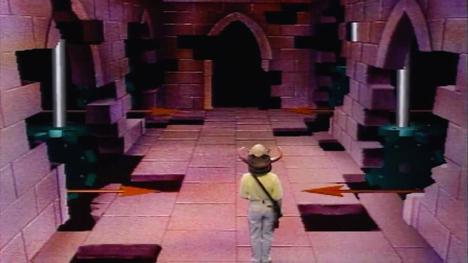
"What I'm doing at the moment is, I'm doing the computer graphics for the Knightmare series for Anglia. This is one of the first scenes in the first episode. Most people will probably have seen it already. It's very, very basic, partially because it's a Level 1 room.
"In a way, it's an introduction to both the dungeoneer and the teams and to the audience, just to lead them in. It's like the foyer of the dungeon, if you like.
"What I can do here is - as soon as the dungeoneer enters that room and they start to describe what appear to be four open doors, just to foil them, I then just tap a key and block the four doors with four portcullises, at which point they immediately panic and say, 'well, how are we going to get out of this space?'
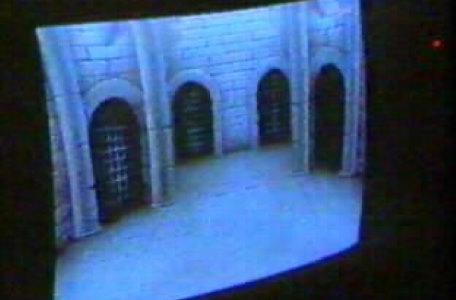
"I then introduce the next clue, which is simple in the extreme, and which everybody knows spells the word OPEN. So, the dungeoneer then walks on the letter O at which point I can tap another key at my leisure and introduce the letter O, the P, the E, the N and then expose a door at the back, which they then go through into the next room."
Gaz Top [Narrator]
Wow - that's incredible. I wouldn't mind having a go at that. If you look carefully, they've even got shadows under the table. Incredible.
Related snippets
Chris Kelly [Presenter]
That's an example of just some of the things you can do with electronic special effects.
But now we're back here in London at the HQ of the Moving Picture Company, and they really are masters of the art. They can create literally any effects they want. In fact, the only limit on what they can do is the imagination of the people using the machinery.
Recently, they've put together a four-minute showreel, which is their way of saying to people who might want to buy their services 'look how clever we are. These are the skills we can offer you...'
Richard Bain [MPC]
New technology of digital video which is a means of layering pictures as many times as you like because it turns the picture into digits the same as would be stored on a floppy disk on your computer. Up until about a year ago this would have been impossible in this country.
Chris Kelly [Presenter]
All the time they're coming up with ever more fantastic effects. The future is going to be fascinating.