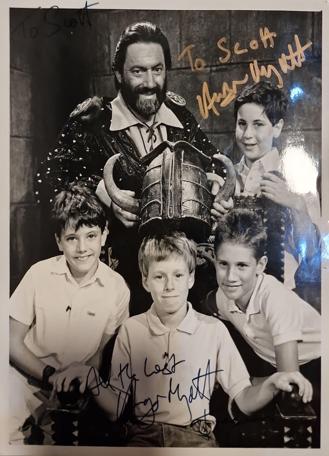
The Series 3 dungeoneer shares his experience of auditioning and participating on the show in 1989.
"I'm not putting myself out there," Scott Evans says, bashfully. "But if I did as poorly as I did on my driving tests, I would have needed all eight seasons to get in."
The engaging Series 3 dungeoneer is telling us about his audition for the show in 1989, which took place in London.
His description of it feels a bit like a driving test, I suggest. The test riddles are given across a table - like some kind of theory test. The test rooms - a clue room and a bomb room - are the practical. (We dare not mention hazard perception.)
"I wish I could remember what those riddles were, because we actually got them right," he says, self-effacingly. During the quest itself, the team scrape past Golgarach with one correct answer.
That sequence typified an error-ridden but thoroughly entertaining adventure, which included some unusual feats: a rare let-off, a collision with a wall that made the cut, a wrong landing off the Spindizzy, and a unique ending in Merlin's chamber.
It's the sort of unpredictable, variety-filled quest that made Series 3 particularly memorable.
"We were young, and maybe didn't take it seriously enough," Scott reflects. "Not that we didn't enjoy ourselves or have a great time, but maybe we missed the actual 'hold-on-a-minute, this is actually a really hard challenge' lightbulb moment."
A year-long mission
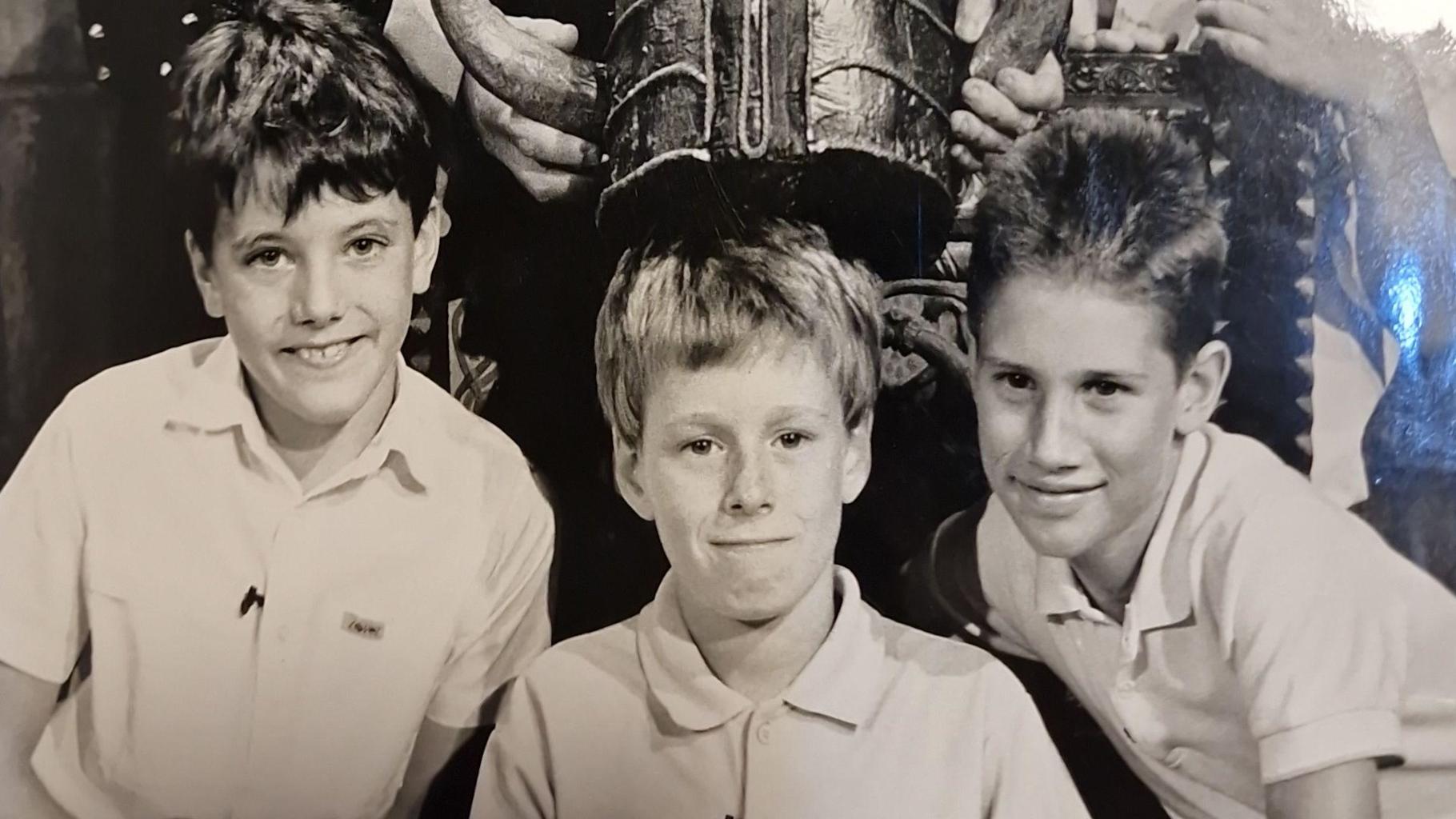
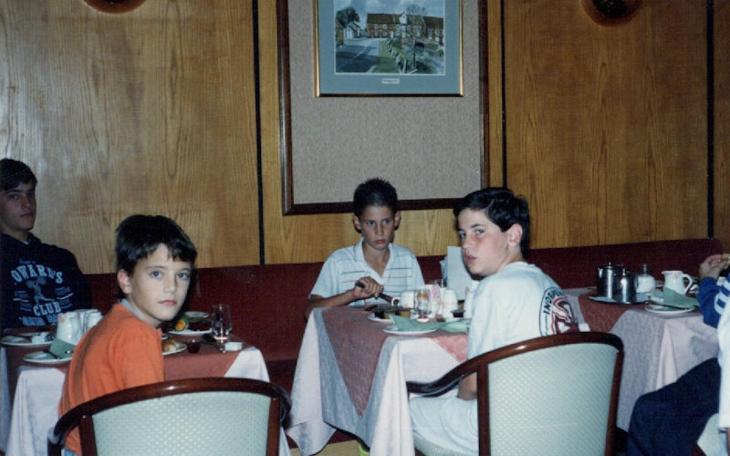
Scott's mission to appear on Knightmare had started the year before, in 1988. He was the avid fan of the four-person team, having followed the show since its first season.
As soon as he was old enough to apply, it was time to throw a hat into the ring with some schoolfriends from Ash Vale in Hampshire.
"Children aren't really known for their patience," he jibes. "I applied for the show as soon as I could. Even in hindsight, I don’t think I would have waited. Perhaps my older self wouldn’t have made it on.
"But as a 10-year-old, you don't tend to fill out many forms. And I do remember my parents were like, 'you want to do this, you do it'," he explains.
"I wasn't particularly interested in school, but I do remember that was one written assignment that I took to with enthusiasm."
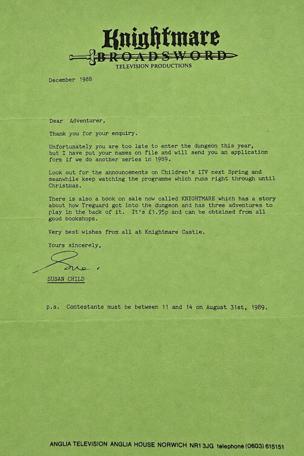
Broadsword responded that the application had arrived too late for the second series, but it would be considered if a third series followed.
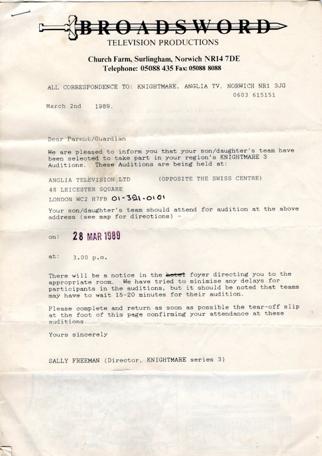
Sure enough, a few months later, an invite to audition arrived. The four boys went up to London and acquitted themselves well.
"Our immediate reaction - out of the door, we're literally high fiving each other," Scott recalls. "You've just stepped out of the studio. High fives, left and right."
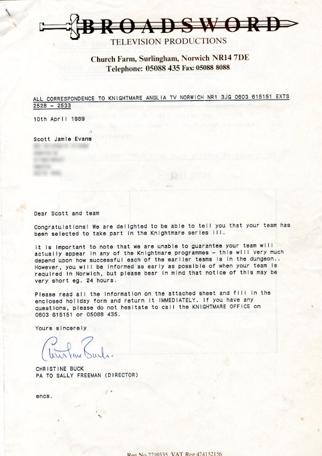
The acceptance was absolutely exhilarating, he explains, but soon coupled with doubt, as teams realise that they face an uncertain summer awaiting a call-up that may or may not come.
"I do wish we'd have prepared more. I wish we'd have practised. I wish we'd had a single goddamn conversation on what to do," Scott says, slightly ruefully.
"I think there was always a nagging 'I bet it doesn't happen' until you get that phone call. From there, it all happens quite quickly.
"But it was the definition of an adventure," he adds. "It was four friends going off to stay away from home, to appear on this show where you go on this quest, where you either win the treasure or you lose your life.
Obviously, the danger wasn't real, but the adventure - every second of it absolutely was.
Peeking too soon?
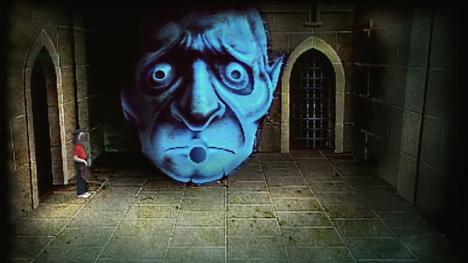
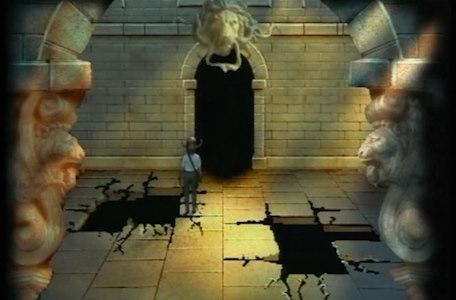
The boys' quest itself had a bit of everything. Successes, mishaps, unique moments. The first incident we dwell on is the Lion's Head, where the team received a rare let off.
The show's long-held reputation of zero-retakes and no second chances has eroded slightly over the years, as more stories emerge about them.
"That bloody Lion's Head room," Scott laughs. "We got the version with the lasers. I'd not long since clattered into a wall, and I think they saw that we probably didn't have the coordination to do a diagonal pathway.
"But at some point, in the room, someone just goes, 'Stop!' They take us aside, and said, 'You've died'. Then they told us that they'd already lost people in that room and so they were going to give us another chance.
They said, 'We don't publicise this. But on occasions we do sometimes, if we feel a team deserves it, give them a second chance.'
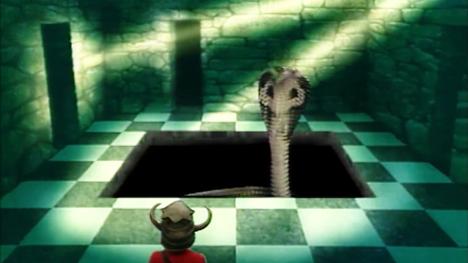
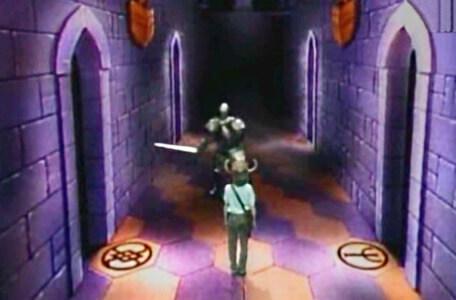
There's no let up from danger. Scott has back-to-back encounters with the behemoth. After peeking to aid his escape in the Corridor of the Catacombs, he was further blindfolded with a mask.
"You do try and have a look at what's in the room," Scott admits. "Is it just literally a blue square, or is there something else in there that differentiates it?
"Is there a table in there? Is there a set of stairs? Are they starting you somewhere else at the beginning of the room, looking into it? Are there some blocks on each side that would indicate that you're in a corridor as opposed to a room?"
But how hazardous is a further blindfold if you're on a moving object? After all, Scott was the only dungeoneer to miss a signalled exit off the Spindizzy.
"When you see that thing spinning around, you're like, 'shit - what on earth is that!?' And of course you can see it - it's on the floor level. You wouldn't have to tilt the old helmet up much to see it there.
"But it was fun!" he says of the Spindizzy scene. "It's not like it span very fast. Obviously, still too fast for me to pick the right door, but it could have gone worse!"
2D or not 2D?
Series 3 had a terrific array of unique endings. Scott would eventually add to that tally, as the only team to fall at Merlin's chamber.
They first realise they are in trouble when they are given a second step - albeit they have no idea what that means until they reach the chasm and realise that they must jump a gap.
Under increased life-force warnings from Treguard, Scott makes the leap. He clears the gap but oversteps the edge. A slithered vector disappears down into the darkness.
"It wasn't even a massive gap," Scott wryly remarks. "It's a hop!"
I suggest a two-footed, Spindizzy-style jump across might have given more control? That's given equally short thrift.
"I would have just jumped straight into the pit if I'd done that," he says, dryly. "Let's not imagine that."
The only chink in Scott's sanguine humour about his time on the show is a suspicion he says has grown over the years that his ending on the show was engineered, perhaps unfairly.
"The way I see it now is that we made an early mistake that presented an opportunity to do something that they hadn't done before," he says. "Which was to get a contestant to jump across the gap rather than walk it.
"They would have known a long time in advance that this was going to happen, so they'd have had time to prepare whatever they were going to do.
"In Merlin's chamber, everything happened very quickly," he continues. "Treguard is giving us the hurry up... I made the jump...
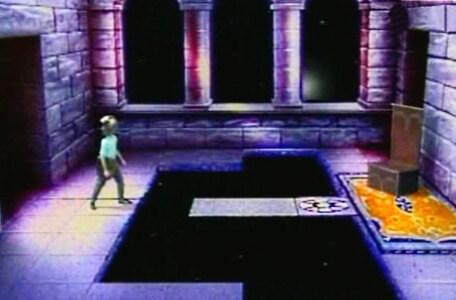
"The thing is: I remember hearing someone in my earphone - a grown-up voice - tell me to take two steps forward. Things did happen quickly, and it's hazy, but I'll go to my grave swearing that I heard it.
"It doesn't really occur to you to question it. Like, 'hold on a minute – who said that?'
"They whipped John Woodnutt into the room in full gear as Merlin, who told us he had two splendid riddles but wouldn't tell us what they were.
"And then, watching it back in the autumn on TV, it makes it look like it was my fault. My advisors say, 'do the jump', they say, 'well done', and then I go forward without being told to do it."
The following team (Julie and co, from Leicester) were already waiting to go in the studios. Scott finds that slightly suspicious too, as there had been no such overlap with Douglas’s team that preceded him.
"How would they be there?" he asks. "Almost as if they're literally about to be filmed straight after this, if that wasn't predetermined?"
I'm less convinced about the outright certainty of it in that chamber. While the odds are stacked against, it's not impossible that they make a jump too accurate to be fudged. And putting an actor through full costume for zero chance of deployment feels a bit of a stretch.
But what jeopardy is there to these magic 'steps' unless one team arrives without them all? A bit of sabotage to nudge Scott over an edge he'd strayed close to is entirely possible.
Tim Child himself admitted at the Knightmare Convention that teams didn't always get their comeuppance at their own convenience. "Sometimes, they got it at mine."
This team might have been one of the most striking examples of that show-running in action.
Til Death Us Do Part
As Scott has discerned over time, this is how the show worked and the business of television. It just leaves some disappointment at not seeing what was next, as any dungeoneer would have.
"I'm not saying we deserved to be a Level 3 team," he concedes. "It's not like we were kicking ass in every room. We made so many silly mistakes in the beginning.
"But if we were going to screw up, it would have been nice to do it completely off our own back.
"Hell, let me get three extra steps forward, get to Merlin, and I'm sure we would have cocked up his riddles anyway. That would have been that."
I can't help but point out that this is more-or-less exactly what happened to the following team, who failed Merlin's riddles and were then ambushed by goblins. Another unique and memorable ending.
So, what's his poison, then? The ending he got, or the ending that followed, if that's how he imagines it might have gone anyway?
"That's very interesting," he pauses. "They're two decent deaths to be honest. And I've watched myself fall down that pit so many times. Would I honestly not like to look at something different for once?
"I think I'd probably stick with what I've got to be honest. That's fair, you know?"
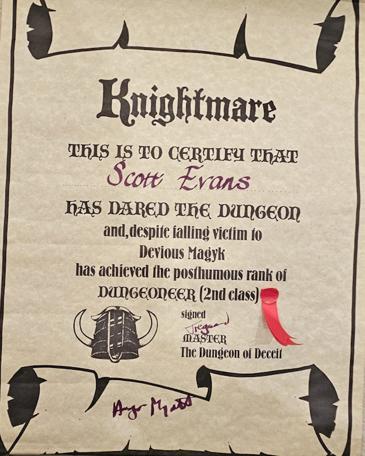
It feels like we've recovered to a positive place. And lest we forget, Series 3 was notoriously difficult. Only three teams reached Level 3, with no winners at all. That must be a consolation, surely?
"Absolutely," he says, not pausing this time. "I love Series 3. It was always going to be my favourite, of course. It's the best example of early Knightmare.
"That sort of claustrophobic, inside-the-dungeon setting, with puzzles and traps and challenges. You could legitimately die or do something that would cause you to die in almost every room. Series 3 is the best example of that.
"I may have perished, but I did it doing the hardest quest for the hardest object during the hardest series," he concludes.
"If you're happy with how things ended up, it's very difficult to look back with any regrets, you know? And I am!"
To be continued...