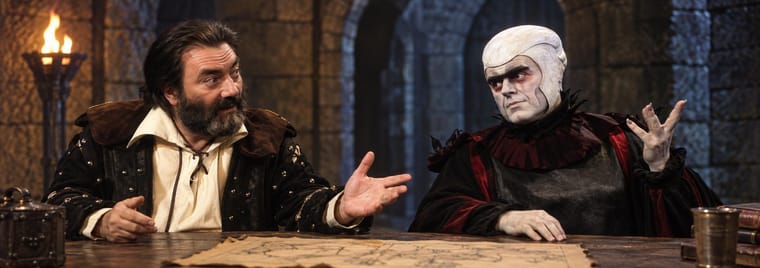
Knightmare in SFX
-
Jolly good! Not sure about the article's last sentence, though (cf. http://www.knightmare.com/history/index4.htm).
-
'Knightmare ended because of a decline in ratings' is an annoyingly frequent misconception, probably because that was the reason given when people tried to apply for KM after Series 8.
It's not helped by the Knightmare article on Everything2.com stating the same, completely contradicting Tim Child's history despite clearly using it as a source up until that bit.
-
I see something interesting in there. Namely the first paragraph.
I mentioned Treasures Of The Mindlord a few months back on here, and it seemed I was just about the only one who remembered it.
Seems someone at SFX does, as well... I wonder if there's any chance it'll be shown again? No idea what happened to the TSW archives when it lost its ITV franchise...
-
Knightmare is in SFX again! Issue 147, September.
Sadly this one is quite a lot briefer than before, not worth a scan really. In the letters section they have a 'Burning Issues' chart with the most popular letter subjects:
Doctor Who: 35%
X-Men 3: 30%
I'm not Gay!: 15%
Lost: 11%
Knightmare: 9%
The resignation of the President of East Timor: 0%
The anoying thing is that even though they supposedly had a few Knightmare related letters, none were printed in the magazine.
But this is still a positive mention - that Children's TV article mentioned several Kids shows and Knightmare is seemingly the only one to have generated interest.
Maybe this'll lead to a larger Knightmare article in SFX, I'll drop in a letter suggesting it. The email is sfx@futurenet.co.uk.
-
Apparantly there is a 5-page article on Knightmare in the September issue of SFX Magazine.
Anyone seen it?
***REWIND
Enter, stranger! Your retrospective guide to Knightmare, TV’s Treguard-hosted classic adventure show. Five pages including rare pics and behind-the-scenes photos…***
-
Thanks for letting us know about this. For those of us who've yet to see the article, this review of it doesn't give much cause for excitement:
http://inamac.livejournal.com/110437.html#cutid1 *
In my view, the article will probably have more value as a nostalgia tour for KM fans who've been dormant since watching the series as children, than for long-term KMers who are well-acquainted with the episodes and behind-the-scenes facts - but actually seeing the article could alter that opinion. Perhaps the most optimistic speculation is that the article is intended to reignite awareness of Knightmare in preparation for whatever Tim Child has stirring.
*As for the review's remark about knightmare.com 'unaccountably' omitting to mention the 60s series Strange Concealments: I don't think it can really be expected to when Tim Child, in all his interviews and website contributions, has never cited Strange Concealments as an inspiration.
-
Alright, have scanned in and uploaded the five page feature from the SFX mag - you can see the article for yourself by clicking on these links:
Sorry that the edges of the article got cut off, I needed to reduce the two page spreads to A4 size so that it could fit into my scanner. If anyone wants me to type the article in full, just ask.
If anyone wants to buy SFX for themselves this coming month, you need to look out for 1 of the 2 Star Wars covers.
If anyone wants to see what members of the SFX forum have to say about Knightmare (contains quotes that featured in the actual mag itself), then you can do so by clicking here:
-
Nearly four years after I uploaded the scans and following a recent post related on the matter elsewhere on this forum, the whole article can now be read exacly word for word below - the only omission being the SFX forum comments that were contained on the final page:
Main article:
Lost in the swirling clichés of time is an age of heroes – heroes who plugged tape recorders into their ZX spectrums and 64s or booted up the school’s faithful BBC Micro.
These bold warriors ventured on quests like The Hobbit, text-based adventure games that allowed early ‘80s tech-heads to travel in the footsteps of Bilbo and co, seeking treasure amid dragons and swordplay with the magic of megabit computing. Meanwhile, the analogue world was swooning at the notion of a twelve-sided dice as the Dungeons & Dragons brand entered the mainstream (there was even a US cartoon series of that name) and millions were hooked on the Fighting Fantasy gamebooks, massively popular “choose your own adventure” multi-option paperbacks including the seminal Warlock of Firetop Mountain.
INTERACTIVE TELLY
Knightmare was a trailblazer in interactive TV gaming, assimilating all of these influences, despite coming from the unlikely hotbed of Norwich, commuter belt base of ITV region Anglia. Home to naff quiz Sale of the Century and the increasingly predictable potboilers of Tales of the Unexpected, Anglia was famed for its on-screen ident of a silver knight statuette; ironic that what eventually became one of the company’s best-selling series worldwide would have a silver knight statue as its prize.
Children’s TV had already picked up on the fantasy gaming trend; the BBC had delivered SF puzzle show The Adventure Game and an interactive outer space mystery mixing live action and comic strip, Captain Zep – Space Detective. ITV had SF-themed gameshows Starstrider (with future Who Sylvester McCoy) and Treasures of the Mindlord. This latest take originated in – of all places – the Anglia TV newsroom.
Tim Child was a producer on nightly magazine About Anglia, then regularly featuring reports on developments in the booming local computing industry. Child’s sister Hilary was a Quality Assurance manager at Sinclair, makers of the famous Spectrum. She kept her brother in touch with the latest games and he was particularly impressed by Atic Atac from game pioneers Ultimate. Players raced around in an ancient castle in pursuit of magic objects, pursued by various nasties. Child reckoned that if a home computer with 48K of onboard memory could produce the attractive, colourful graphics of Atic Atac then surely TV could take it to a new level?
Child was wrong. Anglia lacked the new cutting edge Quantel digital workstations and in fact the show that finally went to air fell back on CSO technology that had been part of the TV toolbox since the dawn of colour. The digitally-enhanced technique used today is known as blue screen but Colour Separation Overlay (called Chromakey in ITV) had to work live in studio, with no post-production facilities. With Child unable to digitally generate a fantasy world he fell back on traditional techniques, employing games cover artist David Rowe to provide airbrushed castle dungeon backdrops straight out of Prog Rock LP-Land. Blue screen meant that the players would be wandering around a completely blue studio for the duration of the game – a useless situation. Then Child hit upon a way round the problem that gave the show on of its key hooks.
One of the team, sent into the studio as the active player, would not be able to see the bluescreen studio and to this end they would be blindfolded by wearing an enormous horned helmet on their head to obscure their vision. With instructions and directions relayed from their three team-mates via an earpiece hidden in the helmet, the “dungeoneer” in the “Helmet of Justice” became an icon of the show out of technical necessity.
KNIGHTMARES AND DREAMSCAPES
As soon as that galloping, none-more-‘80s theme tune (from Ed “Blockbusters” Welch) and title sequence (an animated knight on horseback speeding towards the storm-lashed Knightmare Castle) crashed onto the screen, young viewers were hooked. Plucky spods materialised in the dungeon room of Treguard, the bearded dungeon master who guided the teams on their quests for magic objects. Actor Hugo Myatt and his knowing, twinkle-eyed hamming was vital to the show’s success. Treguard was gloriously ambivalent about the contestants’ success or lack of it and a demise at the hands of a nasty goblin or sinking quicksand would often elicit the offhand comment, “Ooooh... nasty!”
Tim Child recognised that the best game players were those just on the pre-bumfluff cusp of adolescence – old enough to revel in the complexities of the puzzles but young enough for raging hormones and self-consciousness not to have kicked in. When players failed in their quest – which was most of the time – you could see the genuine anguish etched on their little faces.
Players had to pick up food to sustain energy levels of “Life Force” and take and use objects, some with magical spellcasting abilities, to overcome some of the hurdles on their quest. Strange characters dispensed advice and challenges, including Motley the Jester, sexy wood elf Velda and ancient magician Merlin. Careful footwork, guided by the three players in Treguard’s room, was needed for the vision-impaired dungeoneer to avoid falling into crevasses and pits dotted around the settings. Hence the show was punctuated by constant cries of “Left a bit, left a bit – STOP!” and the ever-present worry over whether the Dungeoneers could tell right from left. Other in-game hazards included, erm, giant plastic toy cobras.
Constantly innovating rather than resting on its initial novelty, from the fourth series onwards Knightmare annually reinvented itself. Let’s be honest, for those of us growing up and out of the show’s target age at this point, this marked an end to what we’ll call “the classic era” as it all went to from tongue-in-cheek to camp and, hmm, silly bloomin’ kids stuff.
ITV bosses were complaining that the show lacked pace, so new bits of business were stuck in to jolly things along. Greater character interplay and comic double acts became part of the package shoring up the gameplay – from the fourth series onwards Treguard gained an assistant, the cheeky elf Pickle, and badinage and banter ensued. The same year, the series went “on location”, David Rowe and computer graphics bod Robert Harris generating new backdrops using digitally retouched photographs and footage of the likes of Castle Rising in Norfolk. This got the series out of the claustrophobic and limiting dungeons.
Smirkenorff the flying dragon (a rod-operated puppet introduced the following year) transported the dungeoneer further afield to new challenges and this same fifth season saw the series’ biggest format tweak, with the introduction of a resident villain in opposition to Treguard and his young charges. Lord Fear, in skull-like helmet and skeletal black armour, was reminiscent of Skeletor, arch enemy of the popular He-Man toys and cartoons of the time. Initially quite creepy, the mystical crystal-ball gazer with scary Goa’uld-ish glowing eyes quickly became a clown figure, swapping jokey banter with his reptilian aide Lissard the Atlantean.
ITV’s demand for greater appeal to the youngest viewers diluted the behind-the-sofa quotient of the earlier episodes, with juvenile comedy filling the void. Treguard gained a new helper for Series Seven, Majida, “a crazy little Arabic genie, a bit of an airhead... to lighten the mood” as the publicity put it. Yeah, we gave up on it altogether at this point.
VIRTUALLY IMPOSSIBLE
And we weren’t the only ones. The older child audience of over-10s who were Knightmare’s heartland constituency had, ITV planners reckoned, deserted terrestrial children’s TV by the mid-‘90s for distractions like cable channels and games consoles. This cruel irony meant that ITV in turn abandoned these older kids to chase ratings. Unwilling to oversimplify and retool Knightmare for little kids, Tim Child’s Broadsword company attempted a fantasy gameshow for younger children, Virtually Impossible. Satisfying two audiences simultaneously appeared to be just that, and both the new show and its parent had vanished into the ether by 1995. “Ooooh... nasty!”
Broadsword’s similar sequel concept for Children’s BBC, The Sword of the Sorceror, came to naught as the Beeb began to succumb to the same ratings logic that had vanquished Knightmare... an evil, pernicious influence worthy of Lord Fear himself.
Broadsword’s successor Televirtual continues to trial a Knightmare VR gaming engine of virtual worlds populated by avatars of Treguard and co but admit a new network TV series seems unlikely given prevailing market conditions. The internet or Xbox arenas now seem a more likely home for any possible revival. Passively watching four kids lucky enough to be chosen to play must seem old hat now – somehow it’s hard to watch the hip youth of 2008 watching a kid stumbling around some drawings with what amounts to a bucket on his head.
Sub-articles:
IN THEIR OWN WORDS
Tim Child, Series Creator
A dungeon is a dark, dank, dangerous place... we scared an awful lot of children, but it made for great gameplay once they’d been scared.
Hugo Myatt, Treguard
Each series got better and better. There was more to come and so it was very sad that it ended when it did. And a surprise I have to say, to everyone that worked on it.
TRIVIA
Of around 70 plucky teams who took part, only eight succeeded in their quest and took home the coveted Frightknight statuette. None at all succeeded over the course of the entire third season.
Knightmare was reversioned and made abroad. US pilot Lords of the Game went unsold but versions for the French, German and Spanish markets did succeed – El Rescate Del Talisman featured Spain’s answer to Brian Blessed encouraging kids dressed in red knight costumes on their quests.
Following a day of CSO tests in May 1986, a 15-minute pilot was later made under the title Dungeon Doom.
Bodiam Castle in East Sussex, the setting for many later episodes, had been the location for the 1983 Doctor Who story “The King’s Demons”and also the promo video for “Ant Rap”, a 1981 hit for New Romantic pop act Adam and the Ants.
THREE BEST GAMES
1. Wall Monsters
Wall-mounted faces that posed cryptic riddles (“Sits in a cup but isn’t an egg, Fruits of tree but best never eat... my name I beg.”) First created using rudimentary CG animation with a superimposed actor’s mouth, latterly a primitive VR capture helmet was used. Oh, and the answer was... an acorn.
2. Corridor of Spears
A challenge of co-ordination and trust, the dungeoneer would have to follow their team-mates’ shouted instructions with split-second timing to avoid sets of moving spears. Similar puzzles included rooms that collapsed and a conveyor-belted corridor with giant saws running along the walls!
3. The Bomb Room
On entering a new room, the dungeoneer would suddenly find a fuse burning down on a lethal bomb – they would have just seconds to exit the room. Tim Child later revealed the purpose of this filler challenge: “We’d usually chuck them into a bomb room to scare them witless and sharpen them up.”
THREE BEST TIE-INS
1. The Video Game
With Knightmare inspired by a Spectrum game, the circle was squared with this cassette-based 1987 game. Claiming to “Combine the best elements of traditional adventure with hot arcade action... featuring puzzles and riddles not found before in computer games,” in fact trademark Knightmare posers featured alongside the usual limited graphics.
2. The Adventure Books
Seven challenge gamebooks written by Dave Morris were issued between 1988 and 1994. With thrilling titles such as Fortress of Assassins and The Forbidden Gate, these mixed half prose novella with the business end of multi-option adventure roleplaying. These titles revealed the younger Treguard to have been a Robin Hood-like outlaw, his noble birthright usurped by King John.
3. The... Board Game?!
Transferring to perhaps the most traditional (nay, old hat) game format of all, this MB board game, “A spell-binding medieval game of magic,” was issued in 1991. Players collected treasure items, using dice to battle combatants and cast magic spells. Progress was halted by a series of riddles, although we always suspected the player who owned the game had swotted up on the riddles book.
SPIN-OFFS
Knightmare’s makers Broadsword produced several fantasy game shows at the cutting edge of computer technology in the 1990s; none had the staying power of their perennial favourite, becoming mere footnotes in telly history.
The Satellite Game (BSB 1990)
The estimated 37 people who bought the “squarials” needed to view the five-channel UK satellite service BSB could enjoy this kids’ show on the Galaxy Channel. Test-driving computer-generated Virtual Reality, the technology proved so rubbish Broadsword abandoned plans to take Knightmare VR. David Learner was host Larry the Robot but wound up playing Pickle on Knightmare when BSB fell out of orbit.
Cyberzone (BBC2 1993)
Featuring in Janet Street Porter’s “Yoof TV” Def II strand, this “Gladiators meets Knightmare” effort had sports stars like Tessa Sanderson and Colin Jackson challenging civvy street athletes, set against VR backdrops like medieval citadels and “Technotraz”. Red Dwarf’s Craig Charles hosted its sole series.
Time Busters (BBC2 1993-94)
Sunday morning kids’ series running three seasons. Michael Troughton (son of Doctor Who Mk II) and Tracy-Jane White helped kids prevent Doctor Paradox and his Time Vandals tampering with time, with Buster the time-travelling red Routemaster London bus visiting historic sites and museums.
Virtually Impossible (ITV 1994-95)
Successor to Knightmare, aimed at a still younger demographic. Colourful characters such as host Codsby the fish and villainess Ice Woman couldn’t make up for the simplistic gameplay. Only eight episodes were made.


Hello! It looks like you're interested in this conversation, but you don't have an account yet.
Getting fed up of having to scroll through the same posts each visit? When you register for an account, you'll always come back to exactly where you were before, and choose to be notified of new replies (either via email, or push notification). You'll also be able to save bookmarks and upvote posts to show your appreciation to other community members.
With your input, this post could be even better 💗
Register Login