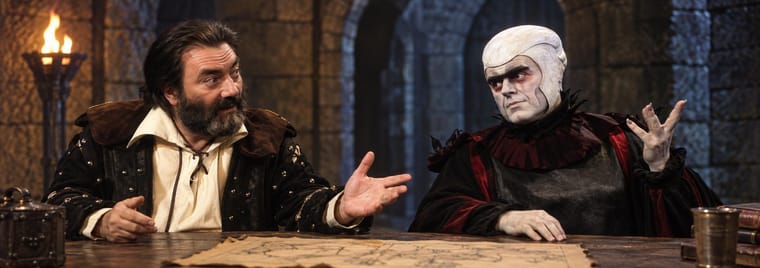
Series 4 Team 7 & Gameplay
-
I don't see any accusations of lying here.
There's been one suggestion - that Tim Child intentionally tried to kill the team off;
and there have been several other statements arguing that such a situation is unlikely to be correct.
As for entering at a funny angle, I just don't see that as conclusive proof at all. It doesn't guarantee their death, it doesn't even really make their job any harder. It just requires them to rotate a bit. I don't have the episode to hand, but how does their angle of entry correspond to their angle of exit from the previous room? Could the incorrect angle be caused by the dungeoneer not quite walking in a straight line into camera shot, or stumbling a bit?
Re-reading the original text, I suspect Tim Child's fury comes from the fact that the TEAM didn't overcome the challenge of the statue, but were told how to do it - rather defeating the point of it being a challenge.
-
I don't see any accusations of lying here.
There's been one suggestion - that Tim Child intentionally tried to kill the team off;
and there have been several other statements arguing that such a situation is unlikely to be correct.
As for entering at a funny angle, I just don't see that as conclusive proof at all. It doesn't guarantee their death, it doesn't even really make their job any harder. It just requires them to rotate a bit. I don't have the episode to hand, but how does their angle of entry correspond to their angle of exit from the previous room? Could the incorrect angle be caused by the dungeoneer not quite walking in a straight line into camera shot, or stumbling a bit?
Re-reading the original text, I suspect Tim Child's fury comes from the fact that the TEAM didn't overcome the challenge of the statue, but were told how to do it - rather defeating the point of it being a challenge.
I understand what your saying Alan and I'm not saying anyone is lying. It's only my opinion! I guess though only Anthony and his team or Tim Child could tell us what really happened.
-
I guess though only Anthony and his team or Tim Child could tell us what really happened.
Well, I guess that's just my point. Tim Child (and, presumably, certain members of the crew) know exactly what happened and why.
Conversely, Anthony and his team only know what they were told.
The idea of Anthony's team being intentionally killed off is simply a theory. It fits some of the facts, but not all of them. I therefore think it's dangerous for people to be assuming that this THEORY is a FACT.
I would say that the facts, as presented to us, also do not lead to the conclusion that David Learner broke rank or that Tim Child was angry because David Learner foiled Tim's plans to kill the team off. Maybe there are more facts that support such theories. Maybe there aren't.
My own experience of Tim was someone who was both very much focussed on fair play and very direct.
I therefore think the above theories clash quite significantly with his personality.
-
I think the notion of fair play in the context of Knightmare is an interesting one to explore.
The makers obviously had to balance the gameshow aspect (with surely had to have strict rules and a level playing field in order to be fair) with making good television.
Quests could obviously be manipulated very easily by throwing teams into easy or hard rooms and I do wonder how much of this went on. I think Hugo Myatt mentioned this in the documentary when he talks about boring teams he wanted to die!
On a related point, Hugo also talked about making quests easier to plan for by making them more linear e.g. whichever door a dungeoneer walked through they'd end up in the same place - only an illusion of choice was presented to teams/viewers. In any other gaming format this would be unacceptable. If the producers wanted it to happen at any point, a team could end up in a room like the block and tackle no matter what they did and where they went.
Is this absence of any real choice compatible with concepts of fair play?
-
Hugo also talked about making quests easier to plan for by making them more linear e.g. whichever door a dungeoneer walked through they'd end up in the same place - only an illusion of choice was presented to teams/viewers. In any other gaming format this would be unacceptable. If the producers wanted it to happen at any point, a team could end up in a room like the block and tackle no matter what they did and where they went.
Is this absence of any real choice compatible with concepts of fair play?
If you think about the various quests undertaken, it really didn't matter which object they set out to redeem or even whether they succeeded in bringing it back. The quest object was a MacGuffin; the important thing was how they performed along the way, proving they were worthy champions.
I think you can look at the "illusion of choice" thing in a similar way. Sometimes it didn't really matter which door they took or which playing card they chose, as long as they demonstrated sound reasoning and the ability to make quick decisions as a team. If they clearly weren't good enough, they were more likely to be punished or given a scare, like sending them into a bomb room to "sharpen them up". I don't think that's unfair.
-
Hugo also talked about making quests easier to plan for by making them more linear e.g. whichever door a dungeoneer walked through they'd end up in the same place - only an illusion of choice was presented to teams/viewers. In any other gaming format this would be unacceptable. If the producers wanted it to happen at any point, a team could end up in a room like the block and tackle no matter what they did and where they went.
Is this absence of any real choice compatible with concepts of fair play?
If you think about the various quests undertaken, it really didn't matter which object they set out to redeem or even whether they succeeded in bringing it back. The quest object was a MacGuffin; the important thing was how they performed along the way, proving they were worthy champions.
I think you can look at the "illusion of choice" thing in a similar way. Sometimes it didn't really matter which door they took or which playing card they chose, as long as they demonstrated sound reasoning and the ability to make quick decisions as a team. If they clearly weren't good enough, they were more likely to be punished or given a scare, like sending them into a bomb room to "sharpen them up". I don't think that's unfair.
Yes your right. But it has to be a fair contest and should be judged on making the correct decisions and not based on the team's personalities. The producers knew what the teams would be like and whether they would be good enough to go on Knightmare. Yes most of the teams could have been quicker with making decisions and being quicker in general, but they were only kids.
-
Yes your right. But it has to be a fair contest and should be judged on making the correct decisions and not based on the team's personalities.
I disagree on that, it was first and foremost a television show and would have been dreadfully dull if teams with no personality could get all the way to the end just by picking the right doors each time! Certainly when I watched the programme, I rooted for the smart, likeable teams and prayed that the dithering, argumentative ones would be killed off soon. They just wouldn't have held onto their audience if every group of mumbling bores were treated with equal "fairness".
The producers knew what the teams would be like and whether they would be good enough to go on Knightmare.
Well, I'd say it's pretty clear from the quality of certain teams that the audition process was not necessarily a good enough indicator of what they'd be like in the studio.
-
I think Canadanne has hit it on the head.
I'd add that, even if you remove the nature of choice, there isn't necessarily a removal of fair play.
To me, a removal of fair play means that, through no fault of the team, the loss is impossible or highly unlikely to be avoidable. That situation doesn't directly arise as a result of a team's choice being removed.
-
I agree that the illusion of choice per se doesn’t make it unfair. However, the inability of a team to directly influence their path through the choices they make, along with the fact that the difficulty level can rise earlier for some teams, doesn’t seem very sportsmanlike (as a concept).
To me, taking a team’s personality into consideration is unfair in terms of gameplay. That said, I agree it makes much better television to favour the interesting teams and Knightmare was obviously a fantastic show so this was probably the right way to run things.
What am I trying to say?
I suppose what I’m saying is that as a kid I thought of Knightmare as a sort of live action Fighting Fantasy adventure – teams would be successful if they chose the correct items and followed the correct path.
I now realise this isn’t the way to think about the show – rather, it’s a role playing adventure in which the producers can alter the script at any time as they see fit. Some of you will no doubt think I’m stating the obvious here!
Better television, but purely as a game, unfair?
-
I suppose what I’m saying is that as a kid I thought of Knightmare as a sort of live action Fighting Fantasy adventure – teams would be successful if they chose the correct items and followed the correct path.
The difference being, of course, that with a gamebook you can go back and see all the bits you missed. When you set up the TV show that way, so much ends up simply going to waste - frustrating for the production team and viewers alike.
I now realise this isn’t the way to think about the show – rather, it’s a role playing adventure in which the producers can alter the script at any time as they see fit.
Isn't that how Dungeons & Dragons works? (I've never played so I'm not sure, but I was under the impression the Dungeon Master could change the rules as he went along.)
If you wanted a truly level playing field, then every team should be given exactly the same adventure - but how boring would that have been?
-
I know it had to be entertaining but for me no matter how interesting the team was in terms of personality, if they made a mistake then they should be punished. Teams who were dithering and ending up making the wrong choice were rightly punished. For me it had to be fair whether a team was boring or not. If a team had a great personality but ending up making wrong decisions yet still ended up winning, would have been a farce.
-
Canadanne wrote:
Isn't that how Dungeons & Dragons works? (I've never played so I'm not sure, but I was under the impression the Dungeon Master could change the rules as he went along.)
If you wanted a truly level playing field, then every team should be given exactly the same adventure - but how boring would that have been?
I completely agree, I just never really thought about Knightmare in these terms.
I always thought about teams being 'contestants' whereas 'players' might be a more accurate term.
I suppose the truth lies somewhere in between (though in which case fairness remains a nebulous concept).
-
I know it had to be entertaining but for me no matter how interesting the team was in terms of personality, if they made a mistake then they should be punished. Teams who were dithering and ending up making the wrong choice were rightly punished. For me it had to be fair whether a team was boring or not. If a team had a great personality but ending up making wrong decisions yet still ended up winning, would have been a farce.
I can only think of one Knightmare team that were killed through no apparent fault of their own (Jamie in Series 2), which I do consider to be unfair - not sure why that happened. I also think there were some harsh deaths, where the correct action was not at all obvious. But mostly they were killed off because they had made a mistake or several, not just because they were dull to watch.
Tim was probably more forgiving of teams that made for better TV, but they still weren't allowed to get away with massive blatant errors, and in my opinion most of the winning teams deserved their victories.
-
I know it had to be entertaining but for me no matter how interesting the team was in terms of personality, if they made a mistake then they should be punished. Teams who were dithering and ending up making the wrong choice were rightly punished. For me it had to be fair whether a team was boring or not. If a team had a great personality but ending up making wrong decisions yet still ended up winning, would have been a farce.
I can only think of one Knightmare team that were killed through no apparent fault of their own (Jamie in Series 2), which I do consider to be unfair - not sure why that happened. I also think there were some harsh deaths, where the correct action was not at all obvious. But mostly they were killed off because they had made a mistake or several, not just because they were dull to watch.
Tim was probably more forgiving of teams that made for better TV, but they still weren't allowed to get away with massive blatant errors, and in my opinion most of the winning teams deserved their victories.
Yeah i agree that most of the winning teams deserved their victories! Jamie's death was very harsh as he had virtually no time to pick up the pieces of the medal spell.
-
Tim was probably more forgiving of teams that made for better TV, but they still weren't allowed to get away with massive blatant errors.
Matt from Series 6 springs instantly to mind for me. Though some would disagree I found him incredibly entertaining and I think in the beginning Tim may have been a bit lenient - I feel he spent far too long on the Level 1 causeway, particularly towards the end (may explain why the timer came in). However, I think he was punished for that on the Level 2 causeway, as watching the video I'm sure others got away with being closer to the edge than he was.
-
Matt from Series 6 springs instantly to mind for me. Though some would disagree I found him incredibly entertaining and I think in the beginning Tim may have been a bit lenient - I feel he spent far too long on the Level 1 causeway, particularly towards the end (may explain why the timer came in). However, I think he was punished for that on the Level 2 causeway, as watching the video I'm sure others got away with being closer to the edge than he was.
Yeah, I agree. I really liked Matt and was gutted by his ridiculously harsh death, but I too think it was a belated punishment for their screw-up on the Level 1 causeway. (They weren't just slow, they actually got away with carelessly wandering onto the wrong block. Tim probably decided it was too early to kill off the first team of the season, but they'd be punished for even the slightest mistake later on.)
-
Earlier in ths thread I refer to a couple of things Hugo said in the anniversary documentary around the illusion of choice and killing boring teams. Having just watched the doc again I can't find any quotes along these ones.
Am I thinking of another interview? Has the doc been re-edited? Or am I just going mad and making things up?!
-
Earlier in ths thread I refer to a couple of things Hugo said in the anniversary documentary around the illusion of choice and killing boring teams. Having just watched the doc again I can't find any quotes along these ones.
Am I thinking of another interview? Has the doc been re-edited? Or am I just going mad and making things up?!
It wasn't the documentary, I think it was this interview you were thinking of!


Hello! It looks like you're interested in this conversation, but you don't have an account yet.
Getting fed up of having to scroll through the same posts each visit? When you register for an account, you'll always come back to exactly where you were before, and choose to be notified of new replies (either via email, or push notification). You'll also be able to save bookmarks and upvote posts to show your appreciation to other community members.
With your input, this post could be even better 💗
Register Login