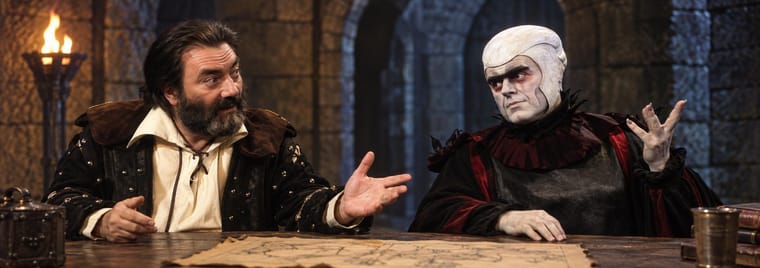
Having just watched the pilot, I do like the way the riddle is actually a riddle rather than a general knowledge question like the riddles always were in Knightmare. Good acting throughout, although Ward's delivery felt a little stilted. This may be deliberate, and his performance certainly wouldn't put me off watching the show when you manage to get things up and running.
Indicating who's talking, if the advisors are on set, it might simply be a case of 'point a camera at them and occasionally cut to them talking/putting an in-vision view of them,' not sure how that would work with the lore you set up, unless Ward's magic connection to the advisors is done by creating magic realm where they can see what the dungeoneer would be able to see... And if that sort of thing doesn't fit with the lore, it might improve the overall product if you bent the lore until it did - It might even be solved simply by having the dungeoneer name the advisors so that Ward can establish a connection with them.
"I can establish a connection to two people from your world, but you have to visualise them in your mind, and name them," that sort of thing certainly helps for figuring out who's who in audio podcasts, and should also helps establish a connection between Dungeoneer and advisors, even if no such connection exists in reality, which I suspect will help the lore of the show. Otherwise it's a bit of a case of 'who are these people Ward's randomly put the life of this unfortunate person in their hands, and why would the dungeoneer trust them' as far as the show's internal logic is concerned - This will also help establish a connection between the advisors and the dungeoneer in the viewer's mind, even if no connection exists in reality. This helps the verisimilitude of the viewing experience, which for semi-fictional sorts of things is probably more neccessary to help us buy into the fiction by making it easy to suspend our disbelief than pure drama. (As for them sounding a bit similar - I hadn't even realised there were two until reading this thread)
For darkness of environment being different on different computers, this both can't be helped but you can easily help deal with it. There are brightness/contrast callibration guides online, I'm unsure which are good and which aren't, but if you callibrate according to one of those, design on the assumption that the viewer will be watching standardised to it, and then provide a link to the callibration, that at least allows viewers to know how they should be adjusting their monitor settings for best viewing experience, even if they choose not to, a bit like a test card, really. (And, yeah, some people's monitor's factory defaults aren't that hot, and if they decide to adjust for your show, it might improve their computer experience across the board)