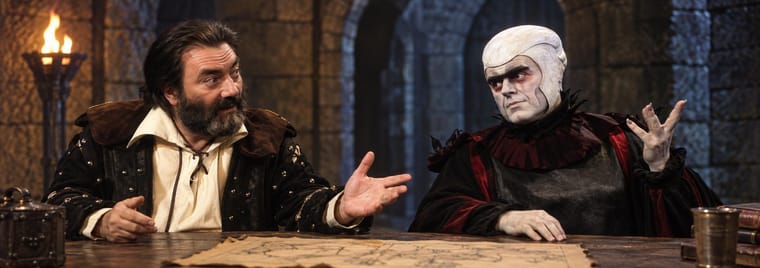

MYTH: Dawn Airey is primarily responsible for the end of Knightmare.
On the 30th anniversary of the final episode, it seems fitting to touch upon this briefly.
I was among those who strongly believed this, as did several Knightmare-based housemates.
That was partly because she is the first name introduced in Tim Child's History of Knightmare, Part 3 (as it is now); partly because she was an instrument of change (a 'reformer', in today's terms); and partly because her career trajectory has always seemed quite ruthless.
That was to last until the Knightmare Convention in 2014. I haven't spoken about this much before, but I did speak with Tim about Dawn Airey during the set-up on Friday afternoon. I cannot remember all of it verbatim, except for his delight in repeating that trio of 'f' words that she became (in)famous for around Channel 5.
But it did strike me quite profoundly just how much of a fan of hers he was – far too much so for somebody that had supposedly deposed the jewel in Broadsword's crown. The data-led approach, of course, was hers. She was in her early 30s (which seems crazy for the role she had) and trying to make strides in a technologically shifting era.
From what I remember, Tim believed Dawn Airey would have kept Knightmare as long as the data proved an appetite for it (which Series 8 absolutely did, versus Virtually Impossible). If anything, she had generated a clearer argument for keeping it, because a crystal clear A/B experiment in that timeslot hadn't worked out. The data in 1994 had bucked the trend.
The reality was more down to the powerplay that took place following Dawn's departure, and other complications. Tim is careful not to apportion blame, and the circumstances are generously explained in the 'history'.
There is, of course, a counter-argument that somebody who experimented with reducing/replacing Knightmare and then left before acting upon any conclusions of that experiment has some culpability for what follows. Fair enough.
But you might find yourself absorbing Tim's testimony slightly differently if you remove Dawn Airey in your mind as the primary villain of the piece. I did.
